
News & Inspiration
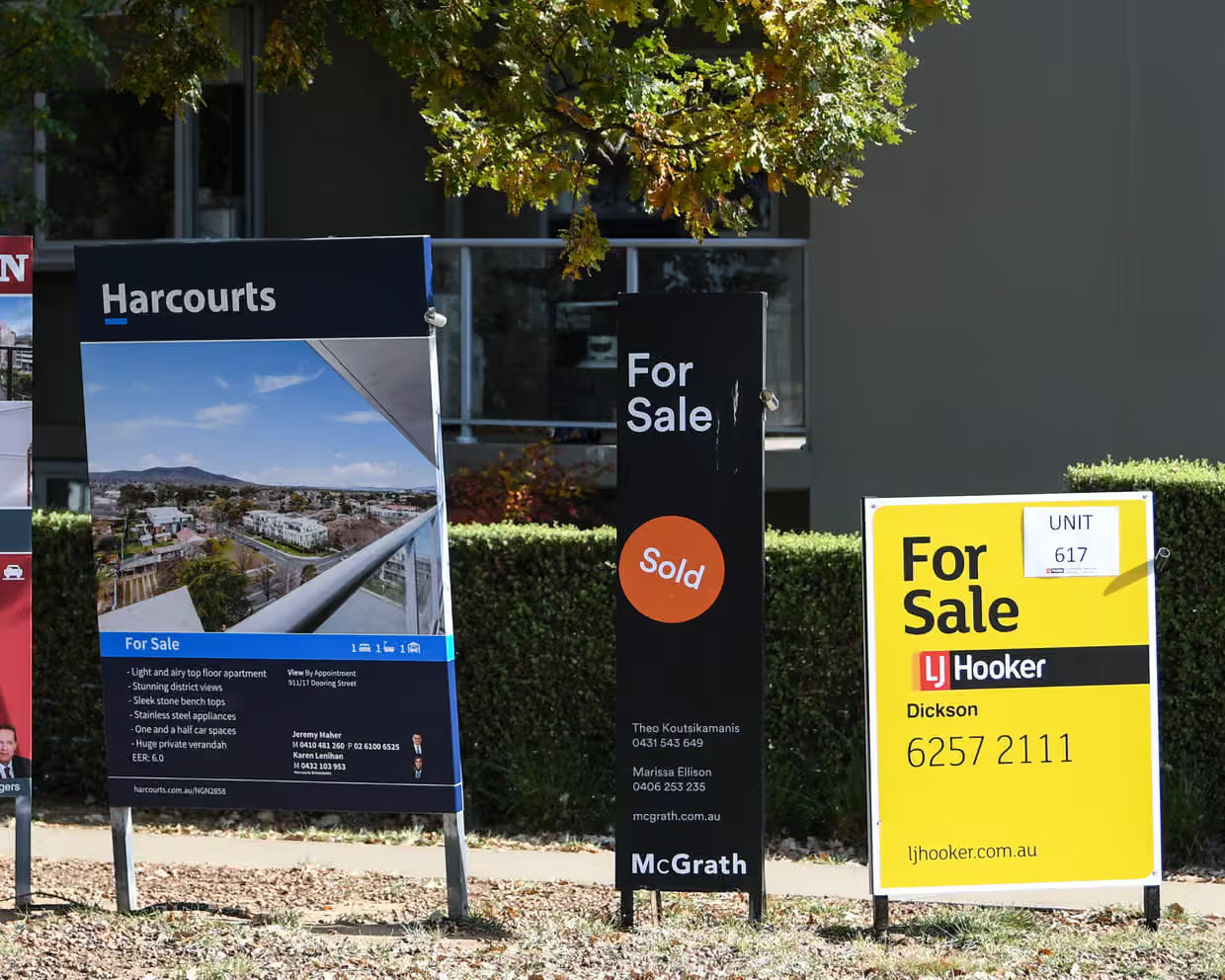
New rules crack down on high risk loans as Australian property market heats up
Regulator announces 20% cap on share of new lending banks can do on mortgages worth more than six times borrower’s income A crackdown on risky lending will limit banks’ capacity to extend highly geared mortgages, as the financial regulator launches a pre-emptive strike against the growing excesses of an overheated property market. The Australian Prudential Regulation Authority announced a 20% cap on the share of new lending that banks can do at a debt-to-income ratio above six – a mortgage worth more than six times the borrower’s income. While Jim Chalmers said the move would “help with financial resilience and housing affordability”, the Greens immediately criticised it as insufficient and experts said it would not curb the current rapid rise in lending growth and property prices. The newly announced restriction lands amid a worsening housing crisis, with a recent report highlighting affordability is now at its worst on record and that a typical household needs to dedicate nearly half of its pre-tax pay to service the average new mortgage. An explosion in lending to landlords has been of particular concern to regulators. Property investors account for two in five new loans, and the value of investor lending surged by 18% in the September quarter alone. The lending restriction will start in February, and Apra’s chair, John Lonsdale, said the regulator was prepared to intervene further. “We will consider additional limits, including investor-specific limits, if we see macro-financial risks significantly rising or a deterioration in lending standards,” he said. It has been a decade since the regulator last intervened to put speed limits on runaway lending, which dragged down home prices. Analysts said the new cap on new high risk lending would not have the same effect. “This is a guardrail for stability, not a handbrake on demand,” said Nicola Powell, Domain’s chief of research and economics. “It won’t cool prices or improve affordability – nor is it meant to. It reins in the riskiest edge of lending.” Apra data shows only 10% of new loans to investors are made at debt-to-income ratios of six or more, and about 4% of new owner-occupier loans – well short of the 20% cap. Jon Mott, a bank analyst at Barrenjoey, said “while it is positive to see Apra is focused on the potential build-up of risk in the housing system given very over-leveraged Australian households, this policy is unlikely to be a binding constraint in the short to medium term”. Chalmers said the new restrictions were “prudent steps to maintain responsible lending”. “These rule changes are an important way for the regulator to reduce risk in our economy, but these efforts will also help when it comes to getting people into homes.” Eliza Owen, the head of research at property data firm Cotality, said limiting high risk lending was “a good move in an environment where investor concentration in the market was unusually high and back to levels seen in the 2010s”. “It’s more likely to have an impact on highly leveraged investors than owner occupiers. It’s more like a preventative measure to stop a blow-out in high debt-to-income lending,” Owen said. “At the end of the day, the regulator can only do so much for housing affordability. That’s more for fiscal policy change, like [reforming] the capital gains tax concession.” Greens senator Barbara Pocock said the move, while a welcome start, did not go far enough and that “first home buyers are being priced out by investors at weekend auctions”. “Apra must use all the tools in their toolbox to rein in investor lending that is exacerbating the housing affordability crisis,” Pocock said.
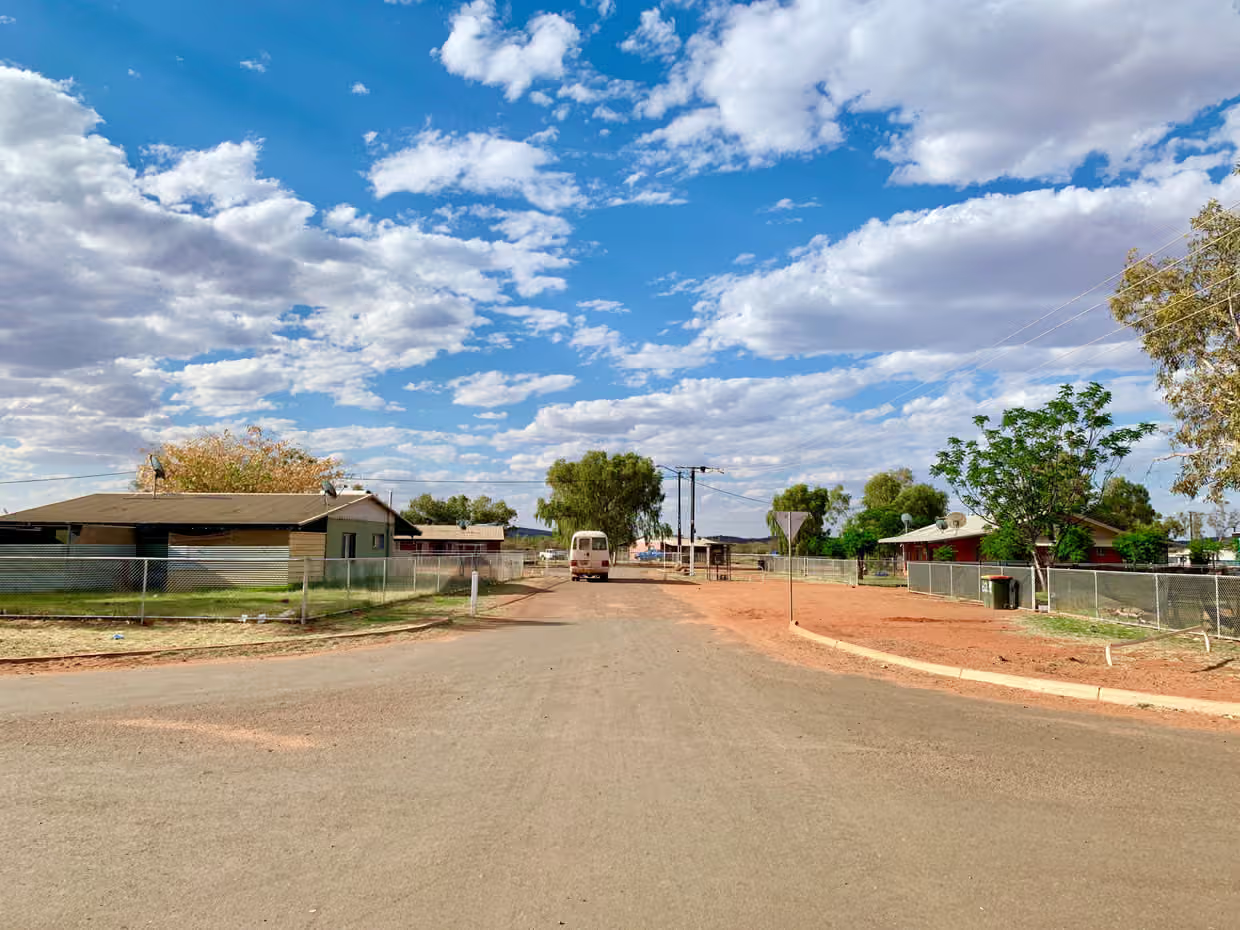
High court overturns NT housing policy which tripled rent in some remote Indigenous communities
Rental changes were introduced in Northern Territory without giving notice to tenants, which the court unanimously ruled was a denial of procedural fairness A public housing policy which saw tenants in the Northern Territory charged a flat rental rate based on the number of bedrooms in their home has been ruled unlawful by the high court, after a three-year challenge brought by residents from two remote Indigenous communities. The Remote Rental Framework, introduced in stages by the NT government between December 2021 and February 2023, raised rent by up to 200% for two-thirds of Aboriginal tenants living in remote communities in the NT, with more than 5,300 homes affected. On Wednesday, the high court found unanimously that the former NT Labor government did not afford the affected tenants procedural fairness, as required under the Housing Act. A summary of the judgment said the rental changes “took effect despite anything to the contrary contained in existing tenancy agreements” and were made “without giving notice to any tenant or inviting any tenant to make submissions regarding the proposed change of rent”. “Accordingly, the making of each determination was infected with jurisdictional error,” the summary said. “Given that conclusion, it was unnecessary for the Court to address whether the determinations were legally unreasonable.” The plaintiffs, Asher Badari, Ricane Galaminda and Lofty Nadjamerrek from Gunbalanya, in West Arnhem Land, along with Carmelena Tilmouth from Laramba, 230km north of Alice Springs, first brought the case against the territory government in September 2022. Outside court, solicitor Dan Kelly from Australian Lawyers for Remote Aboriginal Rights, who has been representing the plaintiffs, said that the NT government should have consulted properly with remote tenants and communities. “The Northern Territory government has to go back and it has to speak to tenants – and they have to speak to communities – and work out what a fair and appropriate rent system looks like,” he said. “They thought they could introduce the policy without any regard to the people affected and their views, so that’s where they went wrong. “The court has upheld this strong presumption in the common law that’s quite an ancient protection for all citizens: that our government can’t exercise power over your rights without talking to you.” The total value of the increased rents was $9.7m a year, Kelly said. An NT government briefing document about the policy claimed consultation had been occurring since 2018. That document said the framework was intended to be “easier for tenants to understand and easier to administer”, and that an income-based model – used to determine public housing rents in other Australian jurisdictions – was “difficult for tenants to understand” and “challenging to administer due to large geographical distances and changing household dynamics”. The Territory housing, local government and community development minister, Steve Edgington, said the NT government acknowledged the high court decision regarding the Remote Rental Framework introduced by the former government, and that “all public housing tenants, remote and urban”, were still required to pay rent. He said the NT government was “considering options” to ensure a valid rental framework was in place for remote tenants. In 2022, the NT government cancelled $68m in rental debt for remote Indigenous communities after a community-led legal challenge argued the housing conditions were “inhumane”.
‘Enclaves for the rich’: new luxury housing is putting parts of Sydney out of reach to all but the very few
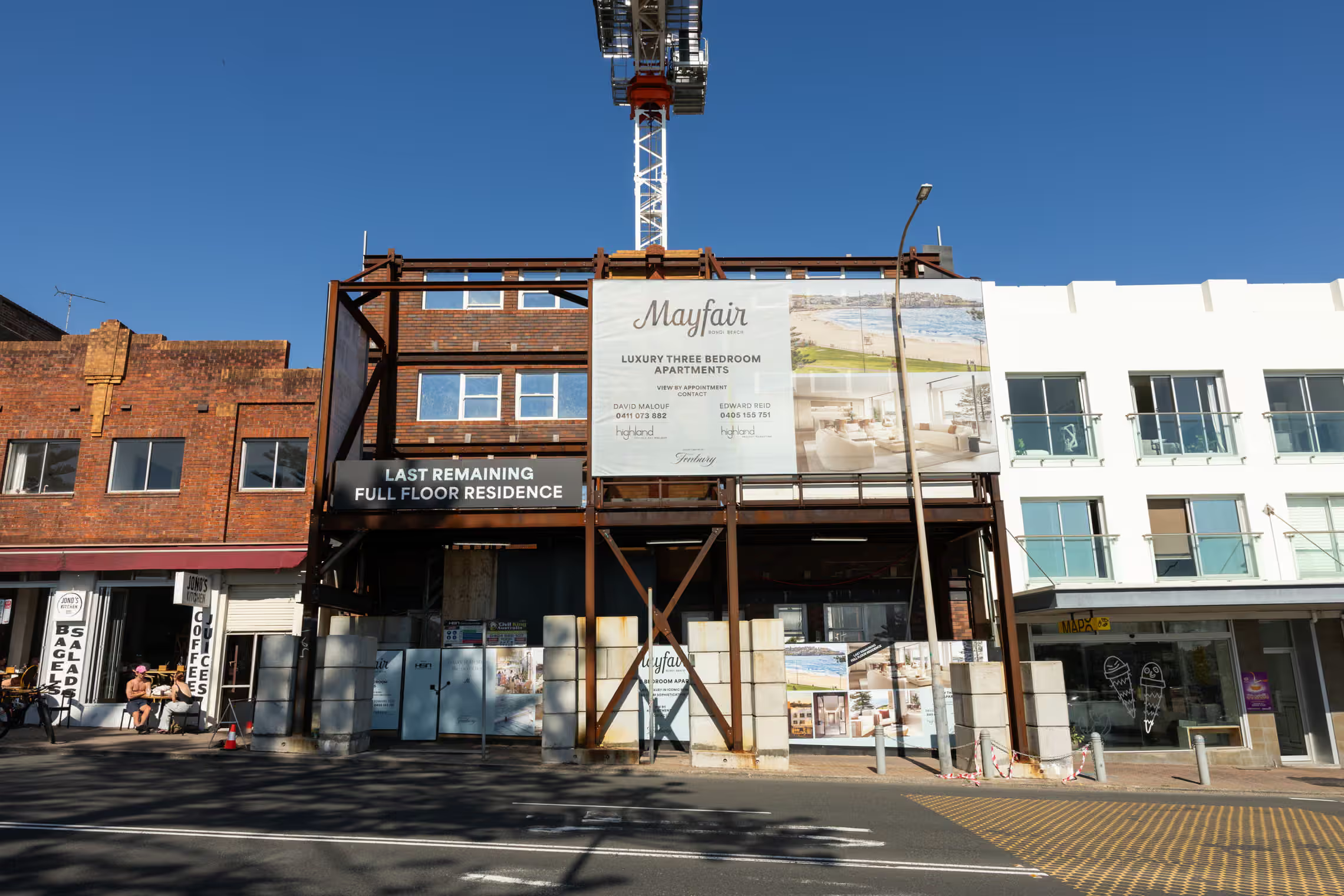
A wave of redevelopment in Bondi, the inner city and lower north shore is pricing people out – even while governments profess to be focused on affordability Bondi used to be home to surfers, backpackers and artists. But the bohemian vibe of Sydney’s most famous beach risks being swamped by a wave of high-end developments. Older apartment blocks that provided affordable housing are being bought by companies and wealthy individuals, who are turning them into smaller blocks with fewer luxury dwellings, or sometimes single homes. Several recent developments are part of a trend that has turned desirable streets into construction zones. In Hastings Parade in North Bondi, one recent development application resulted in 10 units being turned into a single house. On Campbell Parade in Bondi Beach, an art deco block of 16 units at the southern end of the beach has been gutted and is being turned into seven luxury apartments, to be known as the Mayfair. The top floor apartment is marketed at $22m to $24m. Opposite North Bondi surf club, another art deco building on Campbell Parade currently housing a creperie and eight small units with million-dollar views, will make way for two luxury townhouses. Nearby, on Hewlett Street in Bronte, 22 units from the 1960s have been demolished for nine luxury townhouses with an expected price tag of more than $20m each. “It makes a mockery of our housing crisis,” says Paula Masselos, the former Labor mayor of Waverley council, which takes in Bondi beach. “Our affordable housing stock is being cannibalised for expensive housing and it’s becoming a playground for the rich. The super wealthy will be the only people who can live here. It’s really depressing.” Others beg to differ. David Malouf, of Highland Property, which is marketing the Mayfair, says it’s a good thing. “The value is there in Bondi. It’s one of the most iconic beaches in the world. Let’s take advantage of it,” he says. As Sydney grapples with a housing crisis that has already priced many young people out of the market, this latest phenomenon raises serious questions. What sort of city do we want in the future? Should the eastern suburbs, the inner city, the lower north shore, and other areas once celebrated for their diversity, such as Kings Cross, be redeveloped into luxury housing? Isn’t the government trying to increase density and affordability? What happens to communities if key workers, older people, artists and surfers are forced out? ‘Bondi is Bondi because of its diversity’ The City of Sydney has attempted to combat the trend of older blocks of flats being turned into luxury housing with a policy that prevents developers from reducing the number of dwellings by more than 15%. Between 2018 and 2024, there were 25 development applications (DAs) in the City of Sydney council areas, which resulted in the loss of 65 dwellings, a spokesperson says. These included the redevelopment of 13-17 Ithaca Road in Elizabeth Bay, which reduced the number of units from 32 to nine, and the conversion of a seven-unit building on St Neot Avenue in Potts Point into a single house. The council’s attempt to block one high-profile luxury development – the demolition of the Chimes building in Potts Point and the replacement of 80 studio and one-bedroom units with 34 luxury apartments – was stymied by the state government. The NSW Labor government intervened to declare the council’s policy could only apply to applications lodged after it came into force. That meant the controversial Chimes development, backed by one of Australia’s richest businessmen, James Packer, couldn’t be stopped because the DA was lodged before the policy came into effect. “Sydney should not simply become an enclave for the rich. We need more housing, not less,” the City of Sydney lord mayor, Clover Moore, said. “While housing is the responsibility of the NSW government, the City of Sydney is committed to tackling the housing crisis, and we pull every lever we can to address the issue in our local area.” Waverley council looked at a similar dwelling reduction rule in 2024. When its policy limiting the reduction to 15% went on public exhibition it drew 10 submissions in favour and three against. One submission stated: “This is an excellent amendment. It is distressing to see multiple tenants turfed out of their apartments so they can be converted to a single dwelling for the very wealthy.” Another said: “Bondi is Bondi because it has diversity of people. This gives us vibrancy and so many restaurants, shops and facilities to access.” However, when the Liberal mayor, Will Nemesh, who also works as public affairs spokesperson for developer Fivex Commercial Property, took over the reins after the council elections, the policy was dropped. “The proposal was abandoned because it was poor planning policy that would not have achieved its goal of delivering more affordable housing for the Waverley community,” Nemesh says. A Waverley council spokesperson said the council “recognises the importance of affordable housing availability and this year made their largest acquisition of affordable housing stock in close to 20 years”. “The Bondi Junction masterplan, which is a strategic roadmap for Bondi Junction, aims to boost housing supply through providing a mix of dwellings to attract a diverse community.” The NSW planning minister, Paul Scully, says the state government “has actively supported councils developing their own ‘no net dwelling loss’ policies and will continue to support any council that is designing a similar policy”. Apartments left empty by investors On the other side of Sydney Harbour, the same trend can be seen in Neutral Bay and North Sydney. Two interwar blocks of flats at Kurraba Point containing 47 small, relatively affordable units, were snapped up by developer Thirdi Group, which has now developed 24 luxury apartments. The penthouse is on the market with a guide of $40m. “The pocket park opposite used to be filled with children. The kids used to walk to school and mothers used to gather with their prams,” the North Sydney mayor, Zoe Baker says. “That’s all gone.” Baker says a number of new apartments are left empty by investors and overseas buyers. Comment was sought from Thirdi. However, when the Liberal mayor, Will Nemesh, who also works as public affairs spokesperson for developer Fivex Commercial Property, took over the reins after the council elections, the policy was dropped. “The proposal was abandoned because it was poor planning policy that would not have achieved its goal of delivering more affordable housing for the Waverley community,” Nemesh says. A Waverley council spokesperson said the council “recognises the importance of affordable housing availability and this year made their largest acquisition of affordable housing stock in close to 20 years”. “The Bondi Junction masterplan, which is a strategic roadmap for Bondi Junction, aims to boost housing supply through providing a mix of dwellings to attract a diverse community.” The NSW planning minister, Paul Scully, says the state government “has actively supported councils developing their own ‘no net dwelling loss’ policies and will continue to support any council that is designing a similar policy”. Apartments left empty by investors On the other side of Sydney Harbour, the same trend can be seen in Neutral Bay and North Sydney. Two interwar blocks of flats at Kurraba Point containing 47 small, relatively affordable units, were snapped up by developer Thirdi Group, which has now developed 24 luxury apartments. The penthouse is on the market with a guide of $40m. “The pocket park opposite used to be filled with children. The kids used to walk to school and mothers used to gather with their prams,” the North Sydney mayor, Zoe Baker says. “That’s all gone.” Baker says a number of new apartments are left empty by investors and overseas buyers. Comment was sought from Thirdi.
Financial markets now certain the RBA will hike interest rates in 2026
Financial markets are now pricing in a 100% chance the Reserve Bank will hike rates in 2026, in what would be a blow to mortgage holders but may take some steam out of an overheating property market. The latest forecasts represent a turnaround from just two weeks ago, when traders were factoring in an even chance that the next RBA move would be a cut by its May meeting. It comes as data showed inflation is now moving in the wrong direction, alongside this week’s national accounts and household spending figures which showed the economy is accelerating into the new year. There are two big drivers of Australia’s economic growth – but shape matters as much as size Greg Jericho Read more Adam Donaldson, the head of interest rates strategy at the Commonwealth Bank, said “the market has come to the conclusion that the Reserve bank won’t be cutting rates any further”. “Basically, from February onwards, the market is starting to price some risk that rates will go up.” Data from the Australian Bureau of Statistics showed consumer price growth jumped to 3.8% in the year to October – far higher than expected, and well above the top end of the central bank’s 2-3% target range. The pain of higher mortgage costs would be a particular blow to the more than 85,000 first-home buyers this year who have enjoyed three rate cuts in 2025 but now face the prospect of higher repayments.